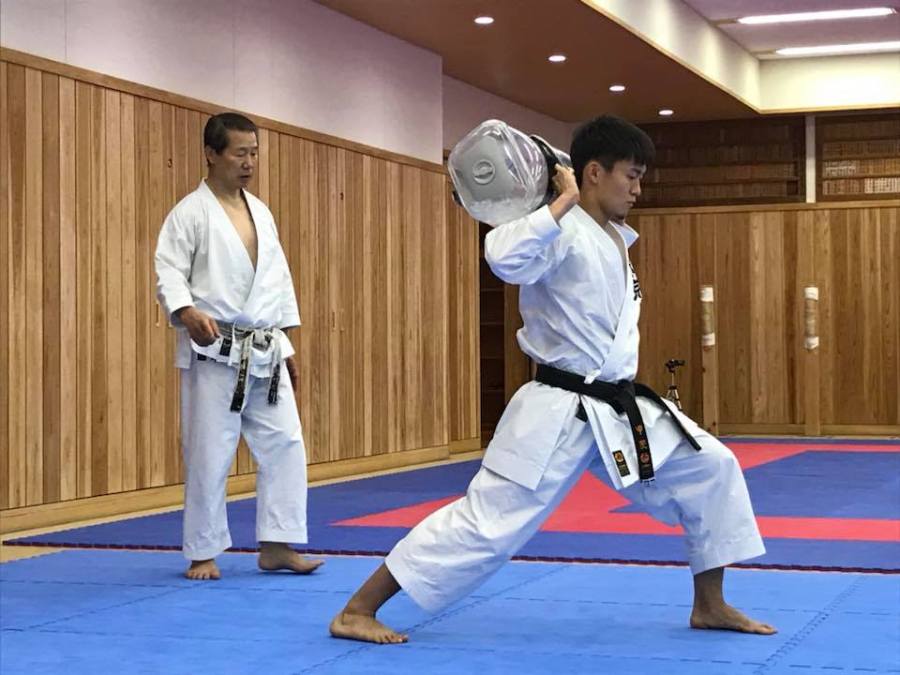

On Saturday the 16th of June a superb National Technical Seminar was conducted at the Teikyo University Budokan.
We started with a very thorough “warm up” (read “agonizing conditioning routines”) with Kanayama Sensei, followed by extensive fundamentals training with Kagawa Shihan. Then, after the break, a class on the Asai-ryu kata Rantai with Yamaguchi Sensei.
Although it was fairly crowded, we still had a lot more space to move in than at the International Seminars (I was able to execute more-or-less full roundhouse kicks during sonoba kihon.
The content of the seminar was excellent, and it was great to meet high-level karate-ka from all over Japan, as well as overseas visitors Kamal Helou Sensei from Lebanon, Johnny Kwan from Hong Kong, and Norman Robinson Sensei from South Africa.
Disclaimer: I am writing this some time after the seminar, and despite my extensive notes, so much was covered that I’ve omitted a lot that I can’t recall well enough to portray accurately. I’m sure I’ll hear about it if I still got anything wrong!
Kagawa Shihan’s Lesson
Just because we had the Kanayama Treatment didn’t mean that Shihan spared our legs
 Kagawa Shihan’s teaching can perhaps be best summed up as ‘moving from the core with correct posture’. Not a new concept to the participants by any means, but it is always excellent to see Shihan demonstrate precisely what we are aiming for, receive his guidance, and train in his latest methods.
Fundamentals practice included deceptively simple stepping exercises (with or without weights and slippery surfaces making it more interesting); sonoba kihon practice with a lot of kicking drills in which he impelled us to strike not only with the leg but to put the whole body behind the blow, be it a snapping, thrusting, or spinning kick; and a punching drill such as Nagaki Sensei often puts us through: starting from heisoku dachi and driving to the front, the side, and then the rear with a spinning gyaku tsuki that really challenges you to maintain good posture while coordinating the spin with the punch, such that the movement is smooth, fast, and makes the fullest use of the driving leg for power generation. Of course, practicing under Kagawa Shihan the demands are even higher but fortunately so is the instruction.
Here Shihan focuses on Arimoto Sensei keeping his jiku ashi anchored, even when pivoting on it
The focus of the day’s numerous challenging kihon drills was keeping stable whilst delivering power, by moving our center of gravity with the correct, maximal use of the legs.
Breaking this concept down further, Sensei then had us all do this following exercise to isolate the leg action he is looking for. This dovetails nicely with the leg training Kanayama Sensei is famous for (which we were not spared this day) and has since been followed up on occasionally by Yamaguchi Sensei in his classes.Hitting with the Body
Sensei then took us to the next logical step—applying these concepts with a partner.
We paired up to wallop each other (not exactly what you’d call kumite), and I was lucky to work with a very experienced chap from up north in Hokkaido who was happy to just be hit and give me helpful feedback. He was in great shape and seemed perfectly relaxed during the whole process, as if being hit was a nice break for him, far more restful than walloping me back! Now, I know what you’re thinking—if you think being hit by me is an easy job, please ask Carlos!This part of the lesson was reminiscent of the little training I’ve done with Steve Ubl Sensei, and having been on the receiving end of The Ubl Experience a couple years back definitely helped me to grasp what Kagawa Shihan was aptly demonstrating here.
“Okurenai” (don’t send it) — i.e. move your body with the punch not before it.
Shihan also took us through the katas Enpi and Junru Nidan, using each one to zoom in on double-hand techniques that gave us another angle on generating power from the legs, and were utilised for further partner drills.
Yamaguchi Sensei – Rantai
Yamaguchi Sensei’s lesson, also excellent, focused on the kata Rantai that was to be the shiteigata for the Asai-ryu kata division at the National Championships later in the summer.
I was reminded (again) how lucky I am to be training at the honbu dojo—a few of us had covered the same kata the week before with Arimoto Sensei, so I got a lot more out of this class than I might have otherwise, perhaps(?) more than some of the prefectural branch leaders who come from across Japan to get the latest from the big boss and his team.Rantai is a challenging kata with a loooooot of kicking going on: the kanji that spell out Rantai are “乱” which stands for disarray, and “脚” which represents legs. As one senior explained to me, after practicing this kata properly you should find your legs in a state of disarray!
Though we focused mainly on the pure, correct performance of the kata, Yamaguchi Sensei of course pulled out a few parts for us to investigate more deeply and practice with a partner:
At the end of the day we all hopped into various cars, trains and taxis heading to a near-ish izakaya. I was pleased to put my mediocre Japanese to use helping ensure international visitors found the place, where I had a great time chatting with some nice chaps from the Tama region, and particularly enjoyed sharing a few drinks and laughs with Anis and Norman Robinson Sensei, who I hope to see again at future National Seminars.
An excellent end to an intense and insightful day!Thanks to Johnny Kwan, the Branch Leader for Hong Kong, for capturing and sharing many photos and videos from the event. I owe you another one! A drink I mean, not a punch. You’ll get that for free 🙂

